HEART RESERVE · Clinical education
Return to activity · Use your browser’s Print command to save a PDF.
Kidney Health Is Heart Health
Clinical learner guide
Use this guide to revisit the teaching and plan the next clinical conversation. Complete the questions and evaluation in the activity. No patient information is collected by this guide.
Learning objectives
- Identify incomplete kidney assessment and select a confirmation plan using eGFR and UACR.
- Match kidney and cardiovascular protection to the patient, demonstrated clinical outcomes and treatment safety.
- Choose a monitoring and referral plan with a named clinician responsible for follow-through.
Case 1 · Denise: the missing kidney test

Denise, 49, is a fictional patient with type 2 diabetes diagnosed three years ago after a remote history of gestational diabetes. She works shifts and helps care for her mother. Today her A1C is 6.7%, blood pressure is 132/80 mmHg, and eGFR is 78 mL/min/1.73 m². The chart contains several metabolic panels but no quantitative urine albumin-to-creatinine ratio, or UACR, during the past year. She says, “I thought the blood test checked my kidneys.”
The immediate teaching problem is incomplete assessment. Her reassuring glucose result and preserved filtration should not close the visit. Before going further, identify what is missing from Denise’s kidney assessment. Denise's pregnancy history belongs in the longitudinal health record, but this encounter is about the kidney-to-heart connection now.
Two measurements answer different questions
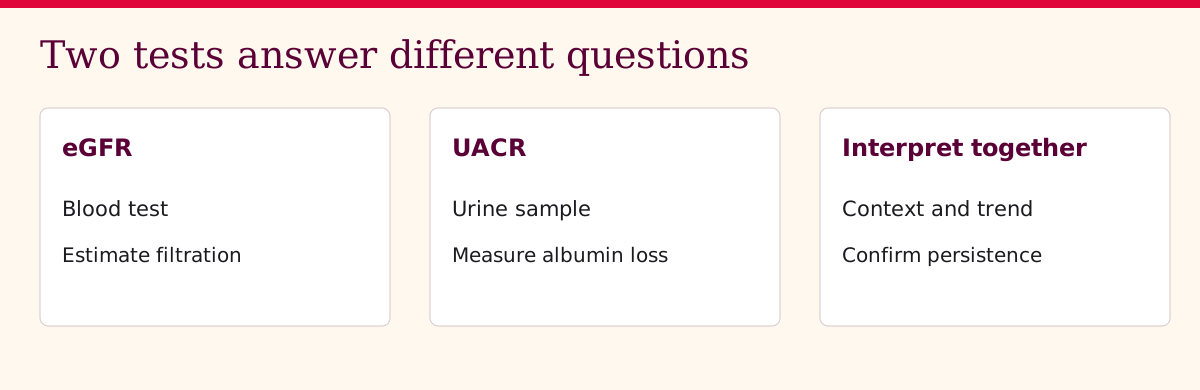
eGFR estimates filtration; UACR measures albumin relative to urine creatinine. The 2026 ADA standard calls for both at least annually in all people with type 2 diabetes. In established CKD, monitoring becomes more frequent according to risk. A normal-looking filtration estimate cannot substitute for the urine measure. [1]
Use the first result to decide what needs verification. A UACR below 30 mg/g is category A1; 30–299 is A2; 300 or more is A3. Interpret these with the filtration category and clinical setting. A single abnormal value does not by itself establish chronic disease. CKD requires an abnormality of kidney structure or function lasting at least three months. Do not apply a chronic label to an acute change without evaluating what happened. [1,2]
The result comes back
Denise's UACR is 86 mg/g. The nurse learns that she had urinary burning when the sample was taken. The next task is to assess and treat the symptomatic problem as clinically indicated, then arrange confirmation. Infection, recent strenuous exercise, menstruation and other transient influences can raise urinary albumin. ADA describes confirmation with two abnormal samples among three collected over three to six months. The clinician must also establish chronicity and interpret the whole record. [1]
This does not mean ignoring the result for six months. Confirm that Denise receives the message, determine an appropriate repeat collection date and document the clinician responsible for interpreting it. If she has acute illness, a rapid deterioration in renal function or other concerning findings, a routine confirmation schedule is inadequate. Clinical urgency always comes first.
Make the missing test easy to complete
Denise can attend laboratory appointments only before an early shift. Ask whether a same-site collection or a coordinated morning visit is feasible. Explain the purpose in plain language: “The blood test and urine test tell us different parts of the kidney story. We need both before we can put the results together.” This original counseling example supports understanding without promising that an abnormal result will disappear.
A practical office workflow is to check for both results before a diabetes review, flag an uncompleted order, and route the result to a named inbox owner. These are proposed implementation choices, not measured results of this activity. The team should adapt them to its own staffing and laboratory arrangements. A new electronic order is not success if the sample is never collected.
Follow-up over the next six months
In the fictional follow-up, the infection has resolved. Two properly collected UACR samples are 74 and 71 mg/g, obtained more than three months apart within a six-month confirmation period, with no identified transient cause and stable eGFR. Denise now needs evaluation of cause, risk and management, rather than a message saying only “mildly abnormal.” The clinical team reviews blood pressure, medications, cardiovascular risk, symptoms and the trajectory. Diabetes can coexist with other kidney disease; atypical features should not automatically be attributed to diabetes. [1,2]
The transfer lesson is a sequence: identify the missing measurement, interpret the result, establish persistence and ensure someone acts. Notice the difference between the medical question—what does the result mean?—and the operational question—who will make sure it is reviewed? Both matter to a woman whose health information is spread across several clinicians.
Take into practice
- Find the eGFR and UACR, with dates.
- Check transient influences and establish chronicity.
- Name the clinician who will review the repeat result.
Case 2 · Rosa: protection beyond A1C

Rosa, 61, is a fictional woman with type 2 diabetes, obesity and confirmed CKD. Over six months her eGFR has remained near 46 mL/min/1.73 m² and UACR near 420 mg/g. Potassium is 4.6 mEq/L. She takes metformin and a tolerated ARB; medication reconciliation finds no SGLT2 inhibitor, GLP-1 receptor agonist or finerenone. Her A1C is 6.5%, at her individualized goal. She asks, “Why add another medicine when the diabetes number is good?”
Rosa's question is reasonable. Begin by explaining the problem the proposed treatment is intended to address. The decision is about kidney disease progression and cardiovascular events as well as glucose control. It is not an automatic instruction to add every available drug on the same day. Establish her current regimen, symptoms, volume status, comorbidities, previous adverse effects, medication access and preferences before selecting a plan.
Separate the glucose goal from organ protection
Published guidance recommends an SGLT2 inhibitor with demonstrated benefit for appropriate people with type 2 diabetes and CKD, with initiation generally supported from eGFR 20 mL/min/1.73 m²; the exact product label and indication still matter. GLP-1 therapy with demonstrated benefit also has a role. The presence of albuminuric CKD should trigger a broader discussion even when A1C is at target. [1,2]
For Rosa, review blood pressure control and whether her ARB is appropriately optimized and tolerated. An ACE inhibitor and ARB should not be combined. Check kidney function, potassium and symptoms when these therapies are initiated or intensified. Treating lipids, smoking, physical activity, nutrition and other cardiovascular risks remains part of comprehensive care; a new drug does not replace that work. [2]
Read the trial before making the claim
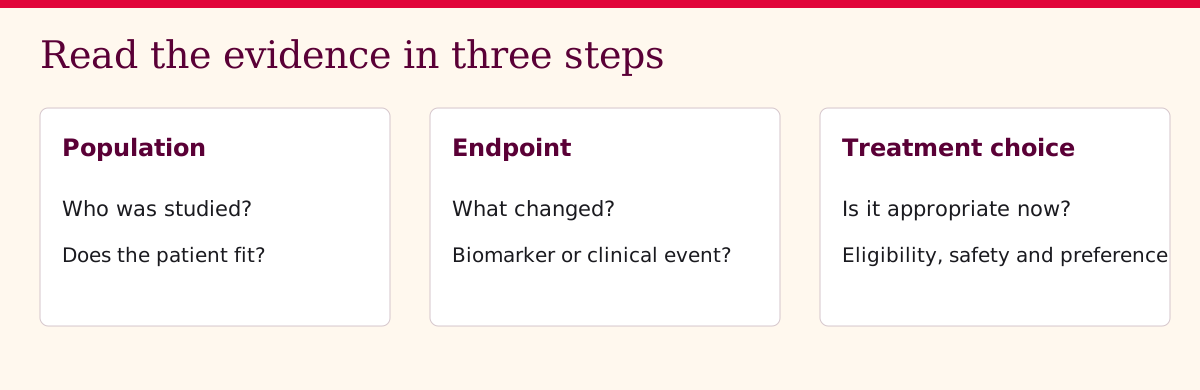
EMPA-KIDNEY enrolled a broad CKD population, including people without diabetes. Its primary outcome combined kidney disease progression with cardiovascular death. DAPA-CKD also studied CKD with and without diabetes, but used different entry criteria and a different composite endpoint. These trials support treatment decisions in suitable populations; they are not a head-to-head comparison of the two medicines. [4,5]
FLOW studied once-weekly injectable semaglutide in people with type 2 diabetes and CKD. Its primary composite included major kidney disease events and kidney-related or cardiovascular death. It provides outcomes evidence for the studied regimen and population. Do not transfer that result automatically to every GLP-1 medicine, formulation or obesity population. The current Ozempic injection label includes a CKD-related risk-reduction indication in adults with type 2 diabetes. [6,10]
FIDELITY pooled the finerenone outcome trials in type 2 diabetes and CKD on background renin–angiotensin system blockade. It reported cardiovascular and kidney benefits. Finerenone therefore enters a discussion about persistent residual risk, together with its potassium and kidney-function requirements. It is not simply an interchangeable blood pressure tablet. [7,9]
| Study | Population and question | Endpoint lesson |
|---|---|---|
| EMPA-KIDNEY [4] | CKD with or without diabetes; empagliflozin versus placebo. | Kidney progression or cardiovascular death; apply its eligibility and outcome definition. |
| DAPA-CKD [5] | Albuminuric CKD with or without diabetes; dapagliflozin versus placebo. | Kidney decline, kidney failure or renal/CV death composite; not a head-to-head comparison with EMPA-KIDNEY. |
| FLOW [6] | Type 2 diabetes with CKD; once-weekly injected semaglutide versus placebo. | Major kidney events or kidney/CV death; avoid transferring results to every incretin product. |
| FIDELITY [7] | Pooled finerenone trials in type 2 diabetes and CKD. | Cardiovascular and kidney composites; potassium eligibility and monitoring remain essential. |
| CONFIDENCE [8] | Finerenone plus empagliflozin versus either alone, on background RAS inhibition. | Relative UACR change at 180 days; distinguish biomarker improvement from comparative clinical-event benefit. |
A useful new study is still a specific study
CONFIDENCE compared finerenone plus empagliflozin with each alone in people with type 2 diabetes, CKD and albuminuria already receiving renin–angiotensin system inhibition. Its primary outcome was relative UACR change at 180 days. Combination therapy reduced UACR more than either monotherapy. That is a biomarker finding, not proof from this trial of fewer kidney failures or cardiovascular deaths versus each component. It can inform a conversation without becoming a claim the study did not test. [8]
Compare the population, endpoint and clinical implication in the evidence table. Ask whether each result answers Rosa’s clinical question, and distinguish a change in albuminuria from a reduction in clinical events.
Shared decisions include practical constraints
Rosa reports recurrent genital yeast infections, worries about medication cost and does not want several unexplained changes at once. An SGLT2 discussion includes the risk of genital infection, volume depletion, and ketoacidosis, which can occur without marked hyperglycemia. She needs individualized sick-day and procedural instructions and a clear route to clinical advice. For empagliflozin, the label specifies withholding for at least three days, if possible, before surgery or procedures with prolonged fasting. Resume according to clinical stability and oral intake guidance. [11]
If considering injectable semaglutide, review its contraindications, including personal or family medullary thyroid carcinoma or MEN2, gastrointestinal tolerability, pancreatitis warnings, retinopathy context, and dehydration-related renal concerns. These are reasons to assess and counsel carefully, not reasons to assume all patients face the same balance of benefit and harm. Use the current full prescribing information for the complete evaluation. [10]
The worked communication example is: “Your glucose goal is one part of the plan. Your kidney results show another risk we can address. Let us compare what each option has been shown to do, what might make it difficult for you, and what follow-up it needs.” Discuss affordable options and assistance through appropriate channels without steering the clinical decision toward a sponsor. Record an agreed next action and review date; the vignette alone cannot determine Rosa's final prescription.
Take into practice
- State the organ-risk goal separately from the glucose goal.
- Match population, endpoint, product and indication.
- Discuss safety, cost, preferences and monitoring together.
Case 3 · Carol: a plan that reaches the next visit

Carol, 67, is a fictional woman with type 2 diabetes, hypertension and persistent albuminuria. Her eGFR is 38 mL/min/1.73 m² and UACR is 560 mg/g. A proposed finerenone prescription is awaiting review. Today's potassium is 5.3 mEq/L. She takes an ARB, sometimes uses an over-the-counter anti-inflammatory medicine, and recently began a salt substitute after reading that it might help blood pressure. She feels well and has a specialist appointment scheduled in eight weeks.
The teaching task is to stop the prescription from moving ahead without review and to establish who is responsible while the referral is pending. Do not infer the cause of the potassium result from the vignette. The clinician needs to assess the specimen, trend, symptoms, medications, supplements and current health. A severely abnormal result or concerning symptoms would change the urgency; this exercise does not provide a universal outpatient hyperkalemia protocol.
Safety changes the next action
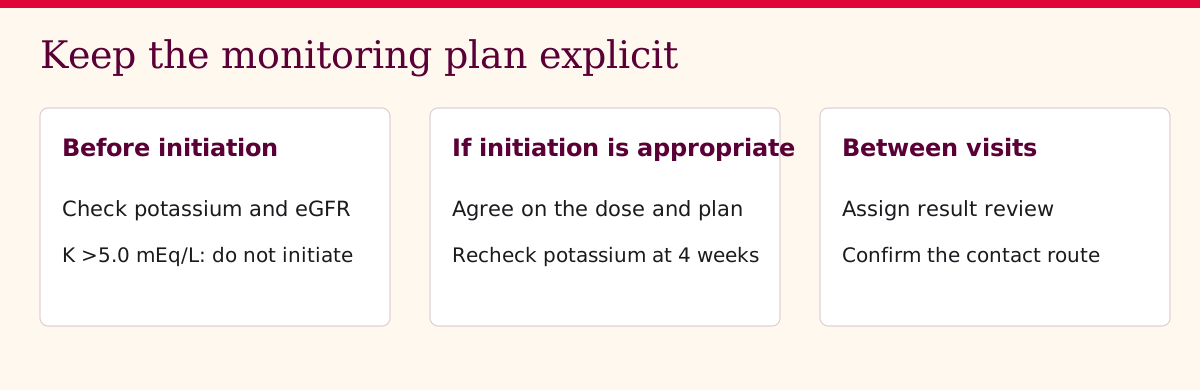
The finerenone US label states that treatment should not be initiated if potassium is above 5.0 mEq/L. Kidney function also affects eligibility and dosing. Review interactions, including strong CYP3A4 inhibitors, and contraindications such as adrenal insufficiency. The label's four-week potassium check after initiation does not justify starting in Carol's current situation or waiting four weeks to address her existing abnormality. [9]
After appropriate assessment and correction, if finerenone is selected and initiation criteria are met, arrange potassium monitoring at four weeks after starting and after dose adjustment, with subsequent testing as clinically indicated. For ACE inhibitor or ARB initiation or dose escalation, KDIGO recommends checking blood pressure, creatinine and potassium within two to four weeks, adjusted to the clinical context. These are different medication-specific follow-up decisions; do not replace them with a generic annual diabetes visit. [2,9]
The medication list includes what the patient buys
Ask Carol to bring or photograph the labels of nonprescription medicines and salt substitutes. Some contain potassium, and kidney function and concomitant therapy affect the advice. Avoid a blanket instruction either to eliminate every potassium-containing food or to use a potassium salt substitute freely. Coordinate individualized dietary review when appropriate. The purpose is a workable plan based on the actual product and laboratory findings, not a generic food restriction.
Carol explains that she is afraid of “bothering” the office. Give her the name of the team handling the next result and a specific contact method. Ask what she would do if she develops new symptoms, cannot obtain the laboratory test, or receives conflicting instructions. Teach-back can reveal that a plan written clearly in the chart was not understood at home. These are original examples of care coordination for discussion and adaptation.
Referral does not transfer care automatically
Progressively rising albuminuria, falling eGFR, uncertainty about cause, difficult electrolyte or blood pressure management, and advanced CKD can prompt nephrology involvement. Active urinary sediment, rapid deterioration or other atypical findings deserve evaluation rather than assuming uncomplicated diabetic kidney disease. [1] Determine the appropriate urgency and send the trends and current medication list with the referral.
The primary team should confirm whether the receiving service accepted the referral and whether the appointment timing is appropriate. Until responsibilities are explicitly agreed, retain an interim owner for current abnormalities and medication decisions. A specialist's name in an electronic order does not establish that the specialist has seen the patient, reviewed the result or agreed to manage it.
A worked follow-up plan
For this teaching example, the prescribing clinician pauses the proposed finerenone initiation, reviews potassium and contributing factors promptly, determines repeat testing and urgency, and communicates the interim plan to Carol. The team checks referral acceptance, sends the renal trend and reconciled medication list, and records who will respond to results before the specialist visit. The final clinical timetable depends on the full assessment. No written learner response is required; compare the plan with the choices below.
At a subsequent visit, Carol reports that she understood the test was needed but could not find transportation. The response should address the barrier and re-evaluate whether delay changes urgency. A missed test is not automatically refusal. A feasible local arrangement, an explained purpose and an agreed result-review process are components of care, not administrative extras.
Carry the kidney story into the heart story
The summary passed to the next clinician should include the kidney measurements and dates, current treatment and tolerance, cardiovascular conditions, the unresolved issue and who is acting next. Include reproductive history when clinically relevant, but do not allow it to crowd out today's priorities. This is the distinctive HEART RESERVE connection: women's histories stay visible while care becomes specific, coordinated and actionable.
Take into practice
- Check the safety result before starting or changing therapy.
- Record test, date, reviewer and patient contact route.
- Confirm referral acceptance and retain interim responsibility.
References
1. American Diabetes Association. Chronic Kidney Disease and Risk Management: Standards of Care in Diabetes—2026. Diabetes Care. 49:S246–S260. https://doi.org/10.2337/dc26-S011
2. KDIGO. 2024 Clinical Practice Guideline for the Evaluation and Management of Chronic Kidney Disease. https://kdigo.org/wp-content/uploads/2024/03/KDIGO-2024-CKD-Guideline.pdf
3. Stempniewicz N, et al. Chronic kidney disease testing among primary care patients with type 2 diabetes across 24 US health care organizations. Diabetes Care. 2021;44:2000–2009. https://doi.org/10.2337/dc20-2715
4. EMPA-KIDNEY Collaborative Group. Empagliflozin in patients with chronic kidney disease. N Engl J Med. 2023;388:117–127. https://doi.org/10.1056/NEJMoa2204233
5. Heerspink HJL, et al. Dapagliflozin in patients with chronic kidney disease. N Engl J Med. 2020;383:1436–1446. https://doi.org/10.1056/NEJMoa2024816
6. Perkovic V, et al. Effects of semaglutide on chronic kidney disease in patients with type 2 diabetes. N Engl J Med. 2024;391:109–121. https://doi.org/10.1056/NEJMoa2403347
7. Agarwal R, et al. Cardiovascular and kidney outcomes with finerenone in patients with type 2 diabetes and chronic kidney disease: FIDELITY pooled analysis. Eur Heart J. 2022;43:474–484. https://doi.org/10.1093/eurheartj/ehab777
8. Agarwal R, et al. Finerenone with empagliflozin in chronic kidney disease and type 2 diabetes. N Engl J Med. 2025;393:533–543. CONFIDENCE. https://pubmed.ncbi.nlm.nih.gov/40470996/
9. Bayer. Kerendia US Prescribing Information. Current label checked October 15, 2026. https://labeling.bayerhealthcare.com/html/products/pi/Kerendia_PI.pdf
10. Novo Nordisk. Ozempic injection US Prescribing Information. Current label checked October 15, 2026. https://www.novo-pi.com/ozempic.pdf
11. Boehringer Ingelheim. Jardiance US Prescribing Information. DailyMed, current record accessed October 15, 2026. https://dailymed.nlm.nih.gov/dailymed/lookup.cfm?setid=5777b8a8-ada6-4950-8548-43a1de11f075
12. KDIGO. Diabetes and CKD guideline status: 2022 remains the current published diabetes guideline; 2026 update is in development. Accessed October 15, 2026. https://kdigo.org/guidelines/diabetes-ckd/
13. AHA/ACC/ADA/ASN et al. 2026 Guideline for the Prevention, Detection, Evaluation, and Management of Cardiovascular-Kidney-Metabolic Syndrome. Published June 9, 2026. Official key points. https://professional.heart.org/en/science-news/2026-guideline-for-the-prevention-detection-evaluation-and-management-of-ckm-syndrome/top-things-to-know
Completion
Three baseline questions, three cases with two required decisions each, six posttest questions and a short evaluation. Passing score: 65% (at least four of six correct). Review feedback and retry when needed. Video, audio and transcripts are equivalent optional learning supports.